
Email Id: sale@adctooling.com
The 2026 search for reliable Railway Wagon Axle suppliers begins with evidence, not attractive brochures. Global buyers need axles that perform under repeated loads, temperature changes, braking forces, and demanding freight cycles. Every mill certificate matters.
UNIFE’s World Rail Market Study 2024 values the worldwide rail supply market at approximately €201.8 billion annually for 2023–2027. Its outlook also indicates continued investment in rolling stock, infrastructure, and rail services. This growth creates opportunity, but it increases procurement pressure. More suppliers do not automatically mean better suppliers.
The UIC’s technical framework and standards such as EN 13261 provide important references for axle materials, manufacturing, testing, and acceptance. Buyers should compare steel grades, ultrasonic inspection methods, heat-treatment records, dimensional tolerances, fatigue data, and traceability systems. A serious supplier should explain how each axle moves from forged billet to finished component. Photos help. Controlled records help more.
AAR M-101 can also guide buyers serving North American freight applications, while regional projects may require different specifications. Certification alone is not enough. Production capacity, corrective-action history, packaging quality, and delivery performance deserve equal attention. One overlooked detail can delay an entire wagon program.
Price is only one variable. A low quotation may hide longer validation work, weaker documentation, or inconsistent machining. This overview examines leading 2026 suppliers through technical capability, compliance, experience, export readiness, and after-sales support. The ranking cannot be perfectly objective. That limitation should remain visible. Reliable decisions require factory evidence, independent verification, and practical dialogue with engineers—not promises alone.
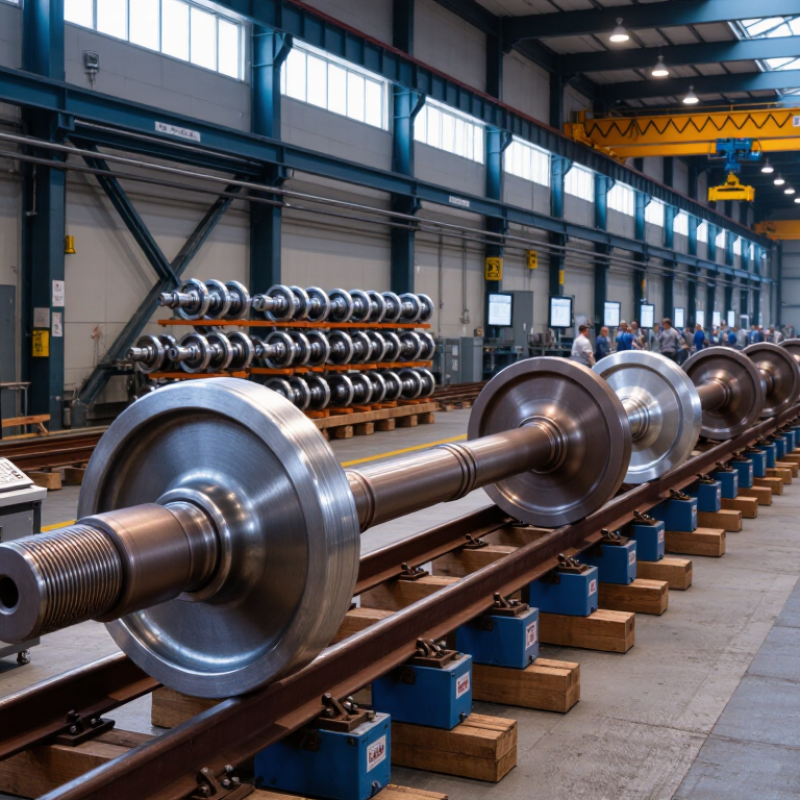
2026 Best Railway Wagon Axle Suppliers for Global Buyers
Railway Wagon Axles: Types, Materials, and Essential Specifications
Railway wagon axles are usually solid or hollow designs. Solid axles suit heavy freight service and remain widely used. Hollow axles reduce weight, but their inspection requirements are stricter. The choice depends on axle load, operating speed, track conditions, and maintenance capacity.
Most reliable axles use forged carbon or low-alloy steel. Controlled heat treatment improves toughness and fatigue resistance. Important specifications include wheel-seat diameter, journal size, axle length, fillet radius, and permitted runout. Buyers should also confirm material certificates, ultrasonic testing, dimensional inspection, and surface hardness records. Small errors matter. A poor fillet finish can create a dangerous stress concentration.
From practical procurement experience, supplier evaluation should include traceability from billet to final machining. Ask for sample inspection reports, fatigue-test evidence, and records from previous railway projects. Check whether packaging protects journals from moisture, impact, and contamination during long ocean transport. Requirements may differ between regions, so applicable railway standards must be agreed before production. Some purchasing teams focus heavily on price. That can be a mistake. I have seen apparently complete specifications omit corrosion protection, replacement limits, or inspection intervals. A clear drawing and realistic acceptance plan prevent costly disputes.
| Axle Type | Typical Construction | Common Material Grades | Typical Railway Use | Indicative Axle Load | Key Technical Specifications | Relevant Standards and Quality Controls |
|---|---|---|---|---|---|---|
| Solid Forged Axle | One-piece axle manufactured from forged steel, followed by heat treatment, machining, and non-destructive testing. | Normalized or normalized-and-tempered carbon and alloy steels; EN 13261 grades such as EA1N, EA1T, and EA4T may be specified according to the design. | General-purpose freight wagons, mineral wagons, container wagons, and intermodal vehicles. | Common freight designs: approximately 20–25 tonnes per axle; heavy-haul designs may be rated at 25–30 tonnes or more when approved by the vehicle design authority. | Wheel seat, journal, and gear-seat diameters are determined by the approved drawing. Common freight journal sizes are often in the approximate 130–160 mm range. Axle end design may use threaded or bolted fastening systems. | EN 13261, AAR M-101, or the applicable national railway specification; dimensional inspection, ultrasonic testing, magnetic-particle testing, hardness testing, and metallurgical verification. |
| Hollow Forged Axle | Forged axle with a controlled internal bore, designed to reduce mass while maintaining the required fatigue strength and stiffness. | High-quality alloy axle steels, commonly selected from approved EN 13261 or equivalent material grades. | Weight-sensitive freight platforms, specialized wagons, passenger-derived freight equipment, and applications requiring reduced unsprung mass. | Typically designed for the same vehicle load class as a comparable solid axle, subject to fatigue calculations and route approval. | Requires controlled bore diameter, wall thickness, concentricity, and surface quality. Internal ultrasonic inspection is essential because the bore introduces additional fatigue-critical surfaces. | EN 13261 or an equivalent approved specification; ultrasonic inspection from multiple directions, dimensional gauging, fatigue assessment, hardness checks, and traceability of heat treatment. |
| Low-Alloy Steel Axle | Forged and heat-treated axle using alloying elements to improve strength, toughness, and resistance to fatigue damage. | Low-alloy steels containing controlled additions such as chromium, nickel, or molybdenum; the exact chemistry must comply with the selected railway standard. | High-load freight wagons, heavy-haul mineral service, and routes with demanding duty cycles. | Often selected for 25-tonne-per-axle and higher-load applications when permitted by the wagon, track, and operating authority. | Important parameters include tensile strength, yield strength, impact toughness, fatigue performance, hardenability, and dimensional stability after heat treatment. | Material certificates, heat-treatment records, tensile and impact testing, ultrasonic testing, magnetic-particle testing, and fatigue or design validation where required. |
| Carbon Steel Axle | Forged axle manufactured from controlled carbon steel with normalization or other specified heat treatment. | Railway-approved carbon axle steels, including grades used under freight axle specifications such as AAR-approved material categories. | Standard freight wagons operating under moderate axle-load and speed conditions. | Commonly used for conventional freight axle loads around 20–23 tonnes, depending on the design and governing standard. | Offers a cost-effective solution when the required strength, toughness, and fatigue life can be achieved. Surface finish and transition radii are critical at journals and wheel seats. | Applicable AAR, EN, or national standard; chemical analysis, tensile testing, hardness testing, ultrasonic testing, magnetic-particle inspection, and dimensional checks. |
| Powered or Gear-Seat Axle | Axle includes a machined gear seat or other interface for transmitting traction torque; it may be solid or hollow depending on the vehicle design. | Alloy steel with strength and toughness suitable for combined bending, torsion, and fatigue loading. | Powered freight vehicles, maintenance vehicles, hybrid rail equipment, and specialized wagon-like rail vehicles. | Determined by the combined vertical axle load and traction torque rather than vertical load alone. | Requires accurate gear-seat geometry, runout control, torsional-strength verification, transition-radius control, and compatibility with the selected gearbox or drive system. | Applicable axle standard plus vehicle-specific traction and fatigue requirements; dimensional inspection, ultrasonic testing, magnetic-particle testing, and torsional or system-level validation. |
| Trailer Wheelset Axle | Non-powered axle fitted with two wheels and intended to support and guide a wagon through the rail-wheel interface. | Approved forged carbon or low-alloy axle steel, selected according to axle load, speed, environmental conditions, and regulatory requirements. | Most conventional freight wagons, including box wagons, gondolas, flat wagons, tank wagons, and covered hopper wagons. | Typical designs range from approximately 20 to 25 tonnes per axle, with heavier ratings requiring specific infrastructure and vehicle approval. | Gauge, wheel-seat spacing, journal dimensions, bearing arrangement, back-to-back wheel dimension, wheel diameter, and brake-disc or brake-rigging interfaces must match the wheelset drawing. | EN 13260 for wheelsets, EN 13261 for axles, EN 13262 for wheels, or applicable national freight standards; complete wheelset dimensional and running-surface inspection. |
| Standard-Gauge Wheelset Axle | Axle designed for a 1,435 mm nominal track gauge wheelset. | Railway-approved forged axle steel; material selection depends on axle load, speed, and regional approval requirements. | International and domestic freight wagon fleets using standard-gauge infrastructure. | Frequently designed around 22.5 tonnes per axle in European freight service, with 25-tonne and higher designs used on selected heavy-haul networks. | Nominal track gauge: 1,435 mm. Wheelset back-to-back distance, wheel profile, journal spacing, and bearing arrangement must follow the applicable regional standard. | EN 13260–EN 13262 series or the applicable national railway standards; gauge, wheel profile, axle runout, wheel-seat position, and bearing-seat tolerances must be verified. |
| Broad-Gauge Wheelset Axle | Axle designed for a broad-gauge wheelset, with dimensions adapted to the relevant network and vehicle envelope. | Forged carbon or low-alloy railway axle steel complying with the purchasing authority’s material specification. | Freight wagons operating on broad-gauge networks, including 1,520 mm and 1,676 mm systems. | Common axle-load classes vary by network and wagon type; approximately 22.5–25 tonnes per axle is used in many freight applications, subject to local approval. | Nominal track gauge may be 1,520 mm or 1,676 mm. Axle overall length, wheel-seat spacing, bearing arrangement, and wheel profile are network-specific. | Applicable regional standards and railway authority requirements; gauge verification, wheelset geometry checks, ultrasonic testing, and full material traceability. |
| Meter-Gauge Wheelset Axle | Compact axle and wheelset designed for a nominal track gauge of 1,000 mm. | Forged axle steel selected for the lower vehicle envelope and the required load, speed, and fatigue duty cycle. | Regional freight wagons, industrial railways, mining lines, and narrow-gauge logistics systems. | Often below standard-gauge freight axle loads, but the exact rating is determined by the infrastructure and wagon design. | Nominal track gauge: 1,000 mm. Compact bearing spacing and wheel diameter may be required; axle strength must account for lateral forces and curve loading. | Applicable national or project-specific standard; wheelset gauge, axle geometry, bearing seats, wheel profile, ultrasonic testing, and fatigue validation. |
| Heavy-Haul Axle | High-capacity forged axle optimized for severe cyclic loading, high gross wagon mass, and demanding operating environments. | High-toughness carbon or low-alloy forged steel with tightly controlled cleanliness, heat treatment, and fatigue performance. | Coal, ore, aggregate, and other bulk-material wagons operating on dedicated heavy-haul routes. | Commonly 25–30 tonnes per axle in approved heavy-haul applications; higher values require specific infrastructure and regulatory authorization. | Requires high fatigue resistance, robust transition radii, controlled surface finish, reliable bearing seats, and compatibility with high-capacity wheels and bearings. | Applicable heavy-haul railway specification; enhanced ultrasonic inspection, magnetic-particle testing, fatigue design review, hardness mapping, and full production traceability. |
| Corrosion-Resistant Service Axle | Standard forged axle protected through controlled surface treatment, coating, sealing, and maintenance procedures rather than relying solely on a corrosion-resistant alloy. | Approved axle steel with suitable toughness and fatigue properties; protective systems must not mask cracks or interfere with inspection. | Tank wagons, chemical-service wagons, coastal routes, humid climates, and environments exposed to de-icing salts or corrosive materials. | Based on the wagon’s structural design; corrosion protection does not by itself increase the permitted axle load. | Critical controls include surface preparation, coating thickness, drainage, sealing of vulnerable interfaces, corrosion allowance where specified, and inspection access. | Applicable axle standard plus coating and hazardous-material wagon requirements; corrosion inspection, coating verification, ultrasonic testing, and periodic in-service examination. |