
Email Id: sale@adctooling.com
Kids Walkie Talkies are small, two-way radios designed for simple, nearby communication. Children can press a button, speak, and release it to listen. Unlike smartphones, most models do not need mobile data, Wi-Fi, or a monthly subscription. They use radio waves instead.
The basic system contains a transmitter, receiver, microphone, speaker, battery, and antenna. When a child presses the push-to-talk button, the device changes voice into a radio signal. The matching unit receives that signal and converts it back into sound. This is called half-duplex communication. Only one person speaks at a time. It sounds simple. Sometimes, it is not.
Don Norman, a leading usability expert, wrote, “Good design is actually a lot harder to notice than poor design.” That idea fits Kids Walkie Talkies well. A reliable pair should have clear buttons, comfortable grips, readable controls, and sound that remains understandable outdoors. Channel settings and privacy codes may reduce unwanted conversations, but they do not create complete privacy. Other compatible radios can sometimes hear the same channel.
Real-world range also varies. Walls, trees, hills, battery strength, and nearby radio activity can weaken the signal. A package may advertise a long distance under ideal conditions. Your backyard may offer less. That gap deserves attention. This guide explains how Kids Walkie Talkies work, what their features mean, and which practical details matter during play, travel, or family activities.
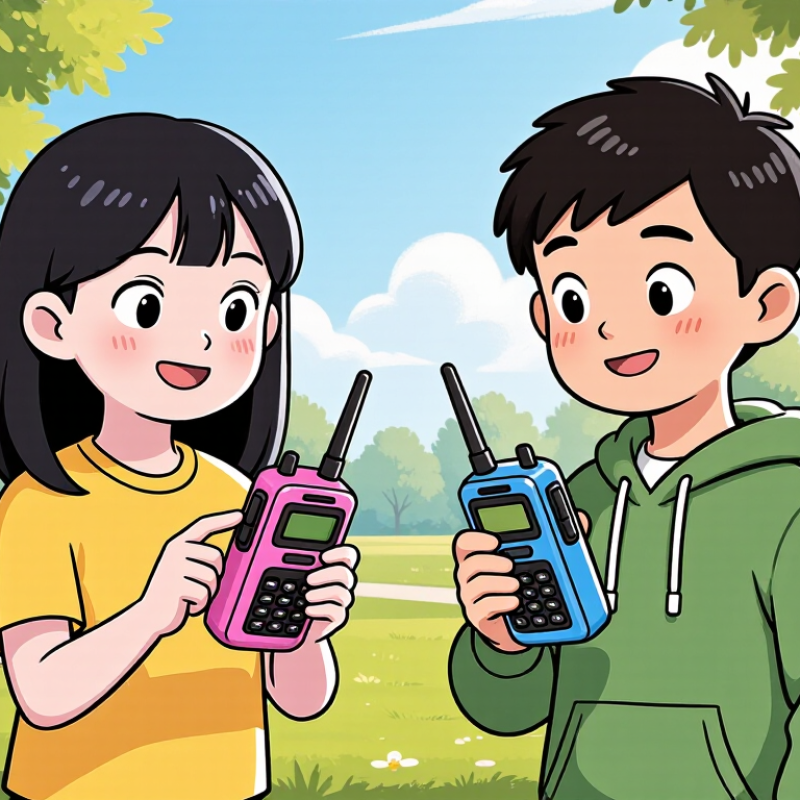
Kids walkie talkies are small, handheld two-way radios designed for short-distance conversations. They let children speak without mobile data, phone numbers, or a cellular signal. Each unit contains a microphone, speaker, battery, antenna, and radio transmitter. Pressing the push-to-talk button sends the child’s voice to another unit on the same channel. Release the button to listen.
Their operation feels simple. Choose the same channel, hold the radio near the mouth, and speak clearly. A child might say, “I’m by the red slide,” while playing outside. The other radio receives the message almost immediately. Actual range depends on buildings, trees, hills, battery strength, and local radio conditions. Advertised distances can seem impressive, but walls often reduce performance.
In my experience, children learn the controls quickly, yet they may forget to release the button. Adult guidance helps them avoid shouting, blocking the speaker, or sharing private information. Many models include volume controls, channel options, belt clips, and battery indicators. Some use rechargeable batteries, while others need replaceable ones. Water resistance can help during light rain, but it does not make every radio waterproof. A walkie talkie is not a private communication device, because nearby users may hear the same channel. That detail is easy to overlook.
Kids walkie-talkies are compact two-way radios designed for short-range voice communication. Their plastic housing protects internal parts from drops, dust, and curious fingers. Inside, a microphone changes speech into electrical signals. A transmitter sends those signals through the antenna as radio waves. The receiving unit reverses this process. Its speaker turns the signal back into audible sound. Clear enough for play. The push-to-talk button controls the conversation. Pressing it activates transmission, while releasing it allows the device to receive. This simple half-duplex design prevents both users from speaking at the same time. In practice, children need reminders to release the button.
A small circuit board manages channels, power, audio filtering, and signal timing. Channel controls help two units communicate on the same setting, although nearby radio activity may cause noise. The volume control changes speaker output, and some models include a call tone or basic light. Batteries supply energy to every component. A secure battery compartment matters, especially around younger children. Rechargeable cells can reduce waste, but they still need correct charging and adult supervision. The antenna may sit inside the casing or extend slightly outside it. Range depends on buildings, trees, terrain, and local radio rules, not just advertised numbers. I have found that a clear outdoor path often works better than a crowded indoor room. That detail is easy to overlook.
Kids’ walkie-talkies are small two-way radios designed for short-distance communication. When a child presses the push-to-talk button, the microphone changes their voice into an electrical signal. The radio then converts it into radio waves and sends it through the antenna. Press, speak, release.
The other unit receives those waves on the same channel. Its antenna collects the signal, while internal circuits filter and decode it. Finally, the speaker changes the signal back into sound. Most children’s models use half-duplex communication, so only one person can speak at a time. If both children press the buttons together, their voices may overlap or disappear. Walls, trees, hills, and weather can weaken the signal. Advertised range may also be measured in open areas, not inside a busy neighborhood. That difference can surprise families.
Tips: Choose the same channel on both units. Hold the radio near your face, but do not cover the antenna. Speak clearly and wait briefly after pressing the button. Test the radios indoors and outdoors before playtime. Replace weak batteries, since low power can reduce performance. Children should avoid sharing private information, even on a quiet channel. Radio signals can travel farther than expected. I once assumed a clear sound meant a secure conversation, but that assumption was wrong. Check the local instructions and supervise younger users.
| Data Dimension | Typical Information | How It Works |
|---|---|---|
| Device Type | Short-range two-way radio | A kids walkie talkie is a handheld radio that allows two or more users to communicate directly without a mobile network or internet connection. |
| Communication Mode | Half-duplex | Users share the same radio channel. Pressing the push-to-talk button enables one device to transmit while the other device listens. Both users normally cannot speak at the same time. |
| Signal Path | Voice to radio wave to voice | The microphone changes speech into an electrical audio signal. The transmitter places that signal onto a radio-frequency carrier wave, and the receiving unit converts the radio signal back into audible sound through its speaker. |
| Common Frequency Areas | Usually within regulated VHF or UHF radio bands | The exact frequency depends on local regulations. Examples include approximately 462–467 MHz for Family Radio Service channels in the United States and 446 MHz for PMR446 equipment in many European countries. |
| Channel Selection | Multiple preset channels | A channel is a designated frequency or frequency pair used for communication. Selecting the same channel on both units allows them to receive each other’s transmissions. |
| Push-to-Talk Control | Press-and-hold button | When the button is held down, the microphone and transmitter are activated. Releasing it returns the device to receiving mode. |
| Transmission Technology | Usually analog FM; some models use digital radio | Analog frequency modulation changes the carrier frequency according to the voice signal. Digital models encode voice as data before transmitting it, which may provide additional features depending on the design. |
| Typical Advertised Range | About 0.5–3 miles under favorable conditions | Actual range is often shorter in neighborhoods, buildings, wooded areas, or hilly terrain. Open, unobstructed ground generally provides better performance than indoor environments. |
| Line of Sight | Important for longer distances | Radio waves travel more effectively when fewer physical obstacles are between the two units. Walls, metal structures, hills, trees, and changes in elevation can weaken the signal. |
| Antenna Function | Transmits and receives radio-frequency energy | The antenna radiates the outgoing radio signal and captures incoming radio energy. A clear antenna area helps maintain reliable communication. |
| Power Source | Disposable or rechargeable batteries | Batteries supply power to the microphone, transmitter, receiver, display, and speaker. Transmission usually consumes more energy than standby or listening. |
| Battery Runtime | Often several hours of active use; longer on standby | Runtime varies with battery capacity, volume, temperature, channel activity, and how frequently the push-to-talk button is used. Manufacturer ratings may be based on a mixture of transmitting, receiving, and standby time. |
| Audio Output | Built-in speaker and microphone | The microphone captures the speaker’s voice, while the receiving unit’s amplifier and speaker reproduce the decoded or demodulated audio. Background noise can reduce clarity. |
| Privacy Expectations | Limited unless strong digital encryption is specifically provided | Many basic walkie talkies use shared, open channels. Other users with compatible equipment may hear transmissions, even when a tone or sub-channel setting is enabled. |
| Interference Sources | Other radios, electrical equipment, and crowded channels | Interference can create static, interruptions, or overlapping voices. Moving to a different channel or location may improve reception when permitted by local radio rules. |
| Sub-Tones or CTCSS/DCS | Optional squelch-control feature | These settings help a radio remain quiet unless it detects a matching tone or code. They do not necessarily make the conversation private or prevent other radios from receiving it. |
| Weather and Emergency Features | Available only on certain models | Some devices may include weather broadcasts, a flashlight, call tones, or an emergency alert. These features depend on the radio design and may not work in every location. |
| Main Advantages | Simple, quick, and network-independent | Walkie talkies can provide instant local communication without subscriptions, phone numbers, cellular coverage, or internet access. |
| Main Limitations | Distance, obstructions, shared channels, and battery dependence | Communication quality decreases with distance and obstacles. Radios also require compatible settings, sufficient battery power, and compliance with local frequency and usage regulations. |
What Are Kids Walkie Talkies and How Do They Work?
Kids walkie talkies are short-range, handheld radios designed for simple voice communication. Each device sends sound through radio waves when a child presses the push-to-talk button. The other unit receives the message on the same channel. Communication usually works best outdoors, between nearby rooms, or across a garden. Walls, hills, trees, and electrical interference can reduce the range.
Common features include multiple channels, volume controls, and simple call tones. Many models also include a built-in flashlight, which helps during evening play or power interruptions. A belt clip can keep the device secure while children move around. Some units use rechargeable batteries, while others require standard batteries. Battery indicators are useful, although they are not always perfectly accurate. This small detail can frustrate children during a long game. Durable plastic and rounded edges also matter because drops are part of normal use.
Tips: Test the devices before children begin playing. Choose the same channel and check the volume first. Teach children to speak clearly and wait before replying. Keep the antenna area uncovered for better reception. Adults should explain that nearby users may hear radio messages. Privacy is limited, even when the devices look advanced. It is also wise to check the operating instructions and local radio requirements before regular use.
What Are Kids Walkie Talkies and How Do They Work?
Kids’ walkie talkies are small two-way radios. A child presses a button, speaks, and releases it to listen. Most models use shared radio channels, so nearby users may hear the conversation. Their stated range often changes with buildings, trees, hills, and weather. A clear backyard signal may weaken inside a house.
How Can Children Use Walkie Talkies Safely?
An adult should inspect the devices before use. Check the battery compartment, charging cable, antenna, and volume level. Keep the sound low enough to protect hearing. Children should use walkie talkies in familiar areas, such as a garden, campsite, or park. Set clear boundaries before play begins. For example, a child may stay between the red gate and the picnic table.
Teach children not to share their full name, address, school, passwords, or daily routine. Radio conversations are not truly private. Children should avoid speaking with unknown users and should change channels when strangers interrupt. They should never rely on a walkie talkie for urgent help. An adult or local emergency service remains essential. Keep the device away from water, roads, and very young children who may swallow loose parts. Supervision still matters. Even careful children forget rules when excited, and that weakness deserves honest planning. A short safety check before each outing can prevent avoidable mistakes.