
Email Id: sale@adctooling.com
Choosing a reliable Ball Bearing Cnc Machine manufacturer requires more than comparing catalog prices. Precision depends on spindle stability, bearing quality, thermal control, software integration, and after-sales support. A machine may look impressive on paper yet struggle during long production runs.
This overview examines leading manufacturers worldwide through practical and technical criteria. It considers machining accuracy, repeatability, automation options, energy use, maintenance access, and operator training. Real workshop details matter. For example, a stable machine should maintain consistent tolerances while cutting hardened steel components, even after hours of operation. Accessible lubrication points and clear diagnostic screens can also reduce downtime.
No supplier is perfect. That matters.
Some manufacturers excel in high-speed production, while others focus on flexible systems for smaller factories. Regional service coverage, spare-part availability, and local engineering support can strongly influence ownership costs. Certifications and published specifications provide useful evidence, but independent testing and customer experience remain important.
The manufacturers discussed here represent different production philosophies and market strengths. Their capabilities should be matched with the buyer’s workload, material requirements, tolerance targets, and budget. A high-end system may be unnecessary for simple batches, while an underpowered machine can become expensive through delays and rework. Careful comparison creates a more dependable decision, especially when the machine will support demanding bearing production for many years.
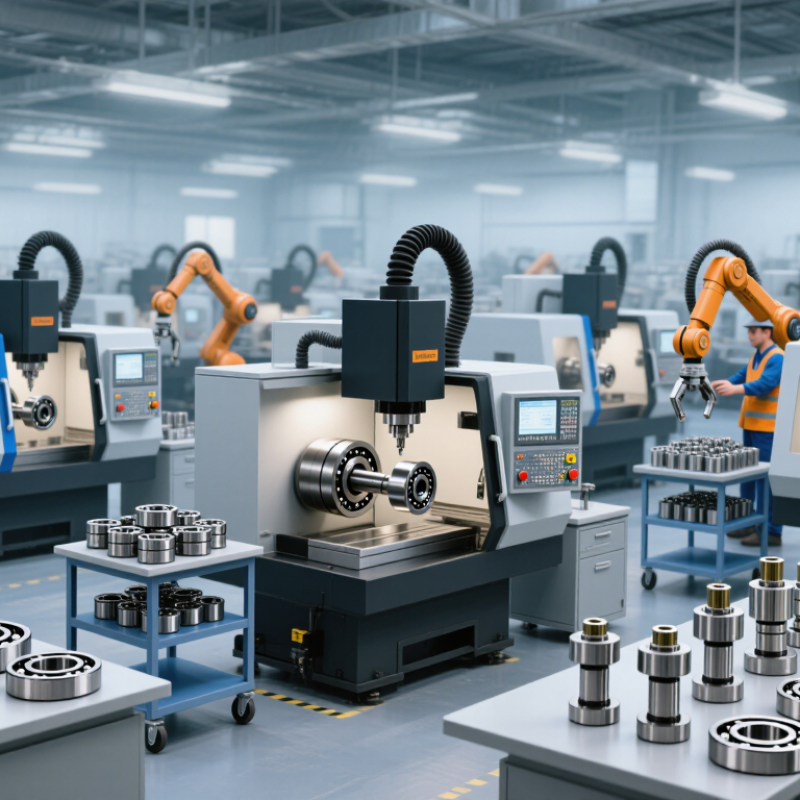
Ball bearings are small components with a large influence on CNC machine accuracy. They support rotating shafts, guide motion, and reduce friction around spindles and drive systems. In high-speed machining, a bearing may face radial loads, axial loads, heat, vibration, and contamination at once. Its performance affects surface finish, positioning repeatability, tool life, and maintenance intervals. Quiet running matters.
CNC manufacturers and equipment builders select bearings by speed rating, preload, stiffness, sealing, lubrication, and expected duty cycle. Angular-contact designs often manage combined loads in spindle assemblies. Precision bearings in ball screws help convert motor rotation into controlled linear movement. Guideways also depend on rolling elements to maintain smooth travel across repeated cycles. A few microns matter. Technicians should inspect temperature rise, unusual noise, grease condition, and play during commissioning. Measured vibration trends can reveal problems earlier than visible damage. Clean installation is equally important. One grain of abrasive dust can mark a raceway and shorten service life.
The global industry includes specialized bearing producers, CNC builders, and maintenance suppliers. Reliable manufacturers publish tolerance data, load ratings, testing methods, and traceability records. Buyers should compare evidence, not only catalog prices. No bearing is perfect. Excessive preload can improve rigidity but create heat, and my own assumption that tighter always means better has proven unreliable. Real operating conditions should guide the specification, especially with coolant, long shifts, or thermal cycling.
Leading ball bearing CNC machine manufacturers are defined by process control, not impressive machine counts. Their equipment must produce smooth raceways, precise bores, and stable fits across long production runs. In factory audits, engineers often inspect spindle vibration, thermal compensation, and tool wear records. Small errors matter.
Core capability begins with rigid machine structures and high-speed, low-runout spindles. Multi-axis turning centers handle ring profiles with fewer setups. Dedicated grinding systems refine raceways to tight tolerances and consistent surface finishes. Automatic loading reduces handling marks and keeps cycle times predictable. Yet automation alone is not enough. Poor calibration can repeat the same mistake faster.
Reliable manufacturers connect machining with measurement. In-process probes check dimensions before defects spread through a batch. Coordinate measuring machines verify geometry, while statistical process control reveals gradual drift. Material knowledge also matters. Hardened bearing steel demands suitable cutting parameters, coolant control, and carefully selected abrasives. Traceable inspection reports support quality decisions and customer audits.
Strong suppliers also provide application engineering, spare-part planning, operator training, and responsive maintenance. These services protect uptime after installation. A practical warning remains: published accuracy may reflect ideal conditions. Real performance depends on foundation stability, temperature, tooling, and operator discipline. Buyers should request sample parts, repeatability data, service records, and references from comparable production environments.
Asia remains the largest production center for ball bearing CNC equipment. Industry reports from Fortune Business Insights estimate the global ball bearing market at about USD 19.5 billion in 2023. Demand is strongest where automotive, electric motor, and industrial automation plants operate together. East Asian manufacturers often compete through high-speed grinding, automated inspection, and compact production cells. Their machines may process bearing rings with impressive repeatability, although service quality can vary between regions.
Europe emphasizes precision, energy efficiency, and long operating life. According to the European Association of Machine Tool Industries, European producers remain influential in high-value machine tool segments. Their equipment commonly includes thermal compensation, in-process measurement, and customized loading systems. North American suppliers often focus on flexible CNC platforms, retrofit capability, and technical support for smaller factories. This category matters when production volumes change quickly.
Other regions are building capacity. The Middle East, Southeast Asia, and parts of Latin America are investing in localized machining and maintenance networks. A 2024 MarketsandMarkets report identifies automation and digital monitoring as major growth drivers in CNC machine tools. However, published market forecasts are not perfectly aligned. Definitions differ. Some reports count complete production lines, while others count individual machines. Buyers should therefore compare spindle accuracy, cycle time, rejection rates, and technician response time, not regional reputation alone. The overlooked detail is practical: a brilliant machine can still underperform beside an unreliable coolant system or poorly trained operator.
Top Ball Bearing CNC Machine Manufacturers Worldwide
Key Criteria for Comparing CNC Machine Manufacturers
A reliable comparison starts with measurable performance, not polished brochures. Check spindle runout, positioning accuracy, thermal stability, and repeatability under realistic workloads. A machine may perform well for one hour, then drift after continuous cutting. Ask for test data from similar bearing components. Look for inspection records, calibration dates, and clear tolerance reports. These details reveal whether quality control is routine or merely promised.
Manufacturing experience also matters. Review the supplier’s history with hardened steel, tight bores, and fine surface finishes. Ask how operators manage vibration, coolant temperature, and tool wear. Strong manufacturers explain their process without hiding behind technical language. They should provide training, spare-part access, and a defined response time for service issues. Certifications can support credibility, but they do not replace practical evidence. No supplier is flawless. I would still question any company claiming zero production risk.
Tips: Request a sample-machining report before purchasing. Compare cycle time, bore accuracy, surface roughness, and rejection rates. Visit the facility if possible, and observe machine maintenance, operator training, and measurement practices. Speak with current users about long-term support, not only delivery speed. Also, calculate total ownership cost, including tooling, energy, calibration, downtime, and software updates. A lower purchase price can become expensive when small errors repeat across thousands of parts. Leave room for uncertainty, because factory conditions rarely match showroom demonstrations.
Ball bearing CNC manufacturing is moving beyond fixed cutting cycles. Modern machines combine high-speed spindles, sensor networks, and adaptive control. During production, vibration sensors can detect an uneven raceway before visible defects appear. The controller then adjusts feed rate, tool pressure, or coolant flow. This protects surface quality and reduces rejected parts.
Digital twins are becoming practical on factory floors. Engineers can simulate spindle loads, thermal expansion, and tool wear before changing a real process. A virtual model may reveal a 0.01-millimeter deviation after extended operation. That detail matters when bearing components require consistent roundness. Machine vision also checks polished surfaces under controlled lighting. It can identify scratches that operators may miss during rapid inspection.
Artificial intelligence helps, but it is not magic. No algorithm is flawless. Poor training data can produce confident mistakes, especially with unusual materials or lighting. Skilled technicians still verify measurements with calibrated gauges and coordinate measuring equipment. Energy monitoring is gaining attention as well. Machines can track idle time, compressed-air leaks, and coolant consumption. These records support more responsible production decisions.
Some facilities are testing collaborative robots for loading and unloading. Their value depends on stable workflows, not impressive demonstrations. Human experience remains essential when tools wear unpredictably or materials behave differently. The strongest manufacturers will likely combine automation with disciplined maintenance, transparent quality records, and engineers willing to question their own data.