
Email Id: sale@adctooling.com
Choosing the right glazing material can shape a project’s appearance, comfort, and long-term performance. Colored Glass Sheet offers architects and contractors a practical way to introduce controlled color into façades, partitions, doors, retail displays, and interior feature walls. Its surface can create a calm blue reflection in a hotel lobby or a warm amber glow beside a reception desk. More than decoration, it can support visual identity and help define how people experience a space.
Global projects need consistency across different climates, suppliers, and installation teams. Colored Glass Sheet can be specified with details such as thickness, color tolerance, surface finish, edge treatment, and safety processing. Experienced teams usually review samples under natural and artificial light before approving a final color. They also check dimensions, packaging, handling procedures, and compatibility with frames or adhesives. Small details matter.
Quality must be verified.
Reliable manufacturers should provide clear technical data, inspection records, and practical guidance for installation and maintenance. Project teams may also request performance testing suited to the intended application and local requirements. This step reduces uncertainty when materials travel across borders or face changing weather conditions. Still, color matching is not perfectly simple. Viewing angle, lighting, and batch variation can affect the final impression. That limitation deserves honest planning, not optimistic assumptions. By combining tested specifications with hands-on review, designers can use Colored Glass Sheet with greater confidence and create spaces that remain distinctive, functional, and credible across international markets.
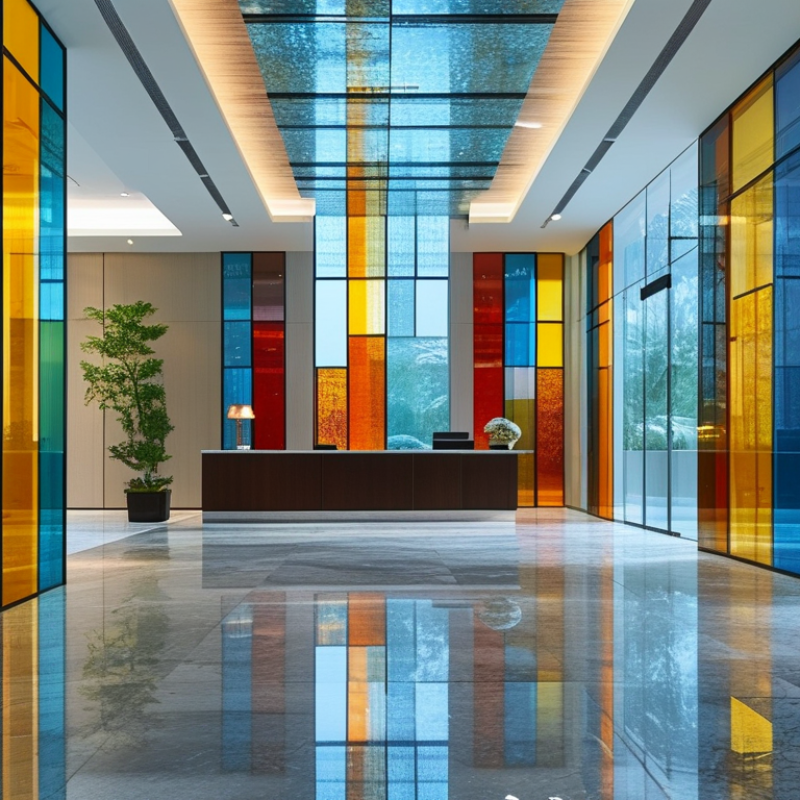
Colored glass sheet is flat glass with color built into its body or applied to its surface. The color may come from mineral additives, ceramic coatings, or laminated interlayers. This process creates shades ranging from soft bronze to deep blue. Unlike ordinary clear glass, it changes both light transmission and visual atmosphere. A sheet can reduce glare, soften daylight, or create a stronger privacy effect.
For global projects, material selection should begin with measurable performance. Architects usually review thickness, color consistency, solar control, thermal stress, and edge quality. A reliable supplier should provide technical data, sample panels, and test results for the intended climate. In coastal regions, salt exposure matters. In hot areas, heat absorption deserves careful checking. Tempered or laminated options can improve safety, depending on the building design and local standards.
Colored glass works well for façades, partitions, doors, furniture, and retail interiors. It can make a reception wall feel cooler or give a stair enclosure more depth. Yet color matching is not always perfect. Natural light, viewing angle, and batch differences can change the appearance. That detail is easy to overlook. Site samples are worth the extra time. Installers should also protect edges from impact and confirm compatible sealants before fitting. A beautiful sheet can still fail when its surrounding system is poorly planned.
Why Choose Colored Glass Sheet for Global Projects?
Colored glass sheet begins with carefully measured silica sand, soda ash, limestone, and mineral colorants. Manufacturers select these materials according to the required shade, light transmission, and chemical stability. Accurate weighing matters. Even a small ratio change can affect the final color.
The ingredients are mixed into a batch and heated in a furnace, often above 1,500°C. The glass must melt evenly without unwanted bubbles or solid particles. Temperature records, furnace controls, and laboratory samples help maintain consistency. This stage demands technical knowledge and constant monitoring.
After refining, molten glass flows onto a bath of liquid tin through the float process. It forms a smooth, level ribbon with controlled thickness. The ribbon then enters an annealing lehr, where gradual cooling reduces internal stress. Inspectors check surface quality, thickness, color, and edge condition before cutting.
Human judgment still matters.
For global projects, manufacturers may produce reference samples before full production. These samples help architects compare color under daylight, indoor lighting, and different viewing angles. No production line is flawless; slight shade variation can occur between batches. Teams should discuss acceptable tolerances early, rather than hide this limitation. Reliable records, documented inspections, and careful packaging support safer handling during long-distance delivery.
Colored glass sheet can support international construction projects when design, climate, and compliance are considered together. The UNEP Global Status Report for Buildings and Construction 2023 reports that buildings consumed 34% of global energy in 2022. They also produced 37% of energy and process-related carbon emissions. Glass cannot solve this challenge alone. However, carefully selected colored glass can control glare, filter strong daylight, and reduce unwanted solar heat in suitable façades.
On site, the benefits become practical. A bronze-tinted sheet can soften harsh afternoon light in a west-facing lobby. A blue or grey tone may help create visual comfort near large curtain walls. Laminated or insulated configurations can also improve safety and thermal performance, depending on the specification. Project teams should verify optical values, U-value, solar heat gain, and visible transmittance. Local climate data matters more than appearance. A mistake is treating color as performance. It is not. The exact result depends on orientation, shading, frame design, and indoor use. International projects also require testing against applicable regional standards, not assumptions from another market.
Tips: Request independent performance data before approval. Compare sample colors under morning, noon, and artificial lighting. Confirm shipping protection, edge quality, and replacement availability. Use whole-building simulation when the façade is extensive. The International Energy Agency continues to identify efficiency improvements as central to reducing building energy demand, but specification choices still need careful review. Designers should document every assumption, including the uncomfortable ones.
Colored glass sheet gives architects a practical way to control atmosphere, daylight, and visual identity. In façades, laminated colored glass can create shaded elevations, entrance canopies, and feature walls without relying on paint. Interior designers use it for partitions, stair balustrades, reception desks, cabinet doors, and illuminated backsplashes. The effect changes with light. A deep amber panel may feel warm in sunlight but appear brown under cool LEDs.
Performance must guide appearance. The United Nations Environment Programme’s 2023 Global Status Report states that buildings account for about 30% of global final energy use and 26% of energy-related emissions. Colored glass alone cannot solve this challenge. Designers should verify solar heat gain, visible transmittance, thermal breaks, and glazing orientation with project-specific calculations. A darker sheet may reduce glare, yet it can also increase lighting demand indoors. That trade-off is often underestimated.
Industry testing should cover impact safety, lamination quality, fire requirements, and long-term color stability. Standards from ASTM and EN provide useful benchmarks for these checks. Site experience also shows small details matter: uneven edges become obvious beside polished metal, and fingerprints remain visible on glossy surfaces. Samples should be viewed outdoors, under workplace lighting, and beside proposed finishes. Color matching is imperfect. Manufacturing tolerances, glass thickness, and viewing angles can change the final result. According to the International Energy Agency, efficient buildings depend on integrated design, not isolated materials. Colored glass works best when aesthetics, daylight, energy, and maintenance are evaluated together.
Typical nominal glass thicknesses used across architectural and interior-design applications
Colored glass sheets support visual zoning, daylight control, privacy, and durable decorative finishes. The thickness values shown are representative specifications commonly used in practice; final selection depends on panel size, support conditions, safety requirements, wind load, and local building codes.
Selecting colored glass for global projects requires more than matching a sample to a mood board. The International Energy Agency reports that buildings consume about 30% of global energy and produce roughly 26% of energy-related emissions. Therefore, evaluate visible light transmission, solar heat gain, and insulation together. A dark sheet may create a dramatic façade, but it can increase cooling demand in hot climates. Ask for tested optical data, not only photographs.
Project location changes the specification. Check wind loads, thermal stress, seismic conditions, and local fire requirements before approving thickness. Laminated or heat-treated glass may improve safety, while interlayers can affect color under ultraviolet exposure. Standards such as EN 12150, EN 14449, ASTM C1048, and ISO 12543 provide useful testing frameworks, but local authorities may require additional evidence. Confirm the exact edition accepted in each market.
Color consistency deserves strict control. Request full-size samples, batch tolerances, light-transmission values, and inspection conditions. Museum-like lighting can hide a mismatch that daylight reveals immediately. Logistics also matter: packaging, container limits, edge protection, and replacement availability should be reviewed early. In practice, teams sometimes approve a small sample too quickly. That is risky. A sheet may look perfect at 500 millimeters, then vary visibly across a 20-meter elevation. Recheck color, performance, and compliance after production trials, not only during design review.
| Selection dimension | Common options or reference data | Recommended choice by project need | Global project consideration |
|---|---|---|---|
| Coloring method | Body-tinted glass, laminated colored interlayer, ceramic-frit glass, or surface-coated glass | Use body-tinted glass for consistent large-area color; use laminated interlayers for layered colors and safety; use ceramic frit for patterns and solar-control effects | Confirm the selected process is available in the required thickness, size, processing method, and destination market |
| Visible light transmission | Typical colored-glass products may range from approximately 5% to 75% visible light transmission, depending on color, thickness, coating, and construction | Choose lower transmission for glare reduction and privacy; choose higher transmission where daylight and interior brightness are priorities | Request photometric data for the complete glass build-up rather than relying only on a color sample |
| Glass thickness | Common monolithic sheet thicknesses include about 4, 5, 6, 8, 10, and 12 mm; laminated and insulated assemblies are specified by total make-up | Select thickness according to span, wind load, impact risk, support conditions, and local structural requirements | A local structural engineer should verify the final thickness because design loads and code requirements vary by location |
| Safety configuration | Heat-strengthened, fully tempered, laminated, or laminated-tempered glass | Use laminated glass where retention after breakage is important; use tempered glass where thermal and mechanical strength are required; combine both where the design requires higher safety performance | Check applicable regional requirements, such as EN 12150, EN 14449, ISO 12543, ASTM C1048, or other project-specified standards |
| Solar and thermal performance | Solar heat gain depends on visible transmission, solar transmission, reflectance, absorption, glass thickness, coatings, and air-gap design | For hot climates, combine suitable color selection with solar-control coating or frit when permitted by the design; for cold climates, prioritize the complete U-value and daylight balance | Evaluate the complete façade or window assembly, not the colored sheet alone |
| Visual color consistency | Color can vary with glass thickness, viewing angle, daylight conditions, batch, and neighboring materials | Approve a physical production sample or mock-up before mass production, especially for curtain walls and uninterrupted elevations | Define acceptable color tolerance, viewing distance, lighting conditions, and inspection procedure in the project documents |
| Fabrication compatibility | Possible processes include cutting, edgework, drilling, CNC shaping, tempering, laminating, insulating, and screen printing | Confirm fabrication before finalizing the color because some coatings and laminated constructions may restrict later processing | Coordinate drawings, tolerances, hole positions, edge details, and packing requirements across all project locations |
| Climate and durability | Consider humidity, salt exposure, ultraviolet radiation, temperature cycling, windborne particles, and thermal stress | Use a tested and appropriately processed glass assembly for coastal, high-altitude, hot, cold, or high-UV environments | Specify sealants, interlayers, edge protection, and installation methods that are compatible with the local climate |
| Size and logistics | Large sheets reduce visible joints but increase weight, handling difficulty, breakage risk, and transport constraints | Balance panel size with container limits, lifting equipment, access routes, installation sequence, and replacement requirements | Confirm maximum feasible dimensions and packaging specifications before issuing final shop drawings |
| Documentation and compliance | Typical documents include product data sheets, safety test reports, optical data, heat-treatment records, quality inspection records, and packing lists | Select a specification that clearly identifies glass type, thickness, color reference, safety treatment, performance values, and inspection criteria | Align documentation with the destination country, project consultant, customs process, and applicable building regulations |
Note: Performance ranges are general planning references. Final values depend on the exact glass composition, thickness, processing method, interlayer, coating, and assembly configuration; project-specific test data should be used for final approval.